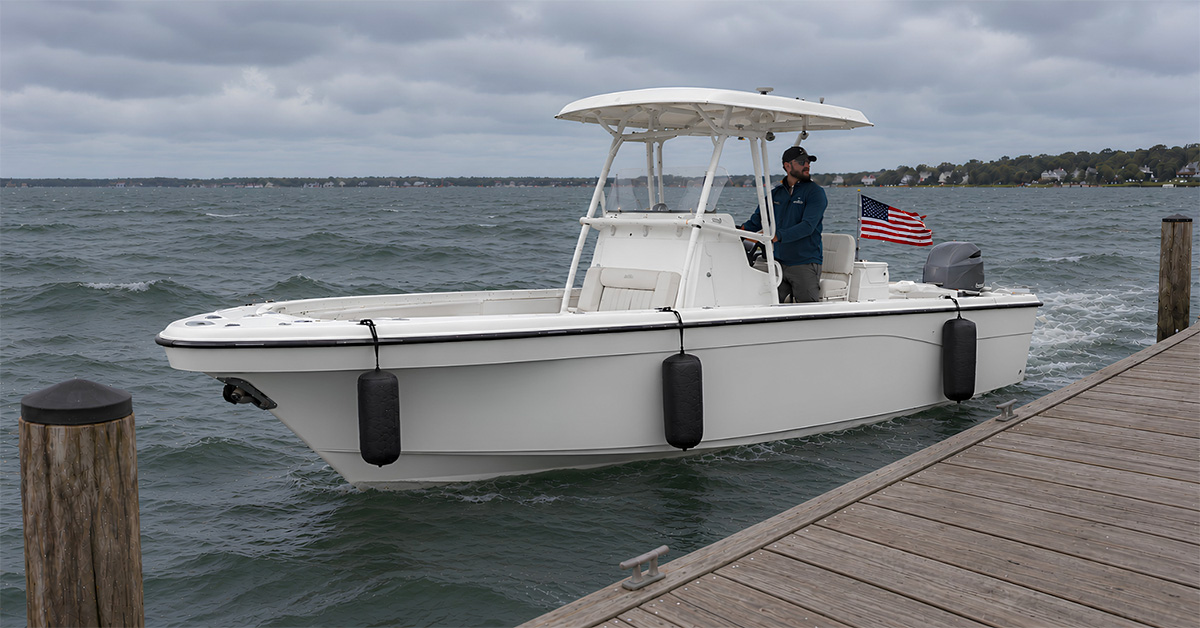
On a calm day, docking is easy enough. That is until the wind starts pushing you sideways and the current pulls you off-angle on the way into a tight slip, usually with someone watching from the dock. Docking in wind and current is a skill you can learn, though. It comes down to picking a sound approach, getting your boat fender placement right before you dock, and practicing until both become second nature.
It works the same way on a 22-foot center console as it does on a 50-foot cruiser. Read the conditions, pick the approach that fits the wind, work with the current, and let your spring lines and fenders handle the rest.
In this article:
- Read the Conditions Before You Approach
- Wind Pushing Toward the Dock
- When Wind Pushes You Away from the Dock
- Handling Wind That Runs Parallel to the Dock
- Make the Current Work for You
- How a Spring Line Pivots Your Boat
- Getting Fender Placement Right Before You Dock
- When to Abort and Try Again
- Docking Checklist for Wind and Current
Read the Conditions Before You Approach
Reading the conditions starts before you’re anywhere near the dock. Slow down as you come into the marina and spend a minute or two watching how the wind and water are moving the boats around you. You’re looking for two things: which force is stronger, wind or current, and whether it’s pushing you toward the dock or away from it. That second answer shapes your whole approach.
Look at how other boats are sitting on their lines. Flags, smoke, or any disturbance on the surface will show you wind direction and strength. Watch the water around pilings and channel markers, too. A visible wake or lean tells you which way the current is running and roughly how hard.
It’s a good habit to make a slow pass near your slip before you commit. Don’t rush it. That pass shows you how the boat wants to drift and how hard it’s being pushed, so you can change the plan before you’re in close. It also gives your crew time to get fenders deployed and lines ready.
Quick tip: If both wind and current are present, build your approach around the stronger one, but don’t forget about the other.
Wind Pushing Toward the Dock
When the wind is blowing you onto the dock, it does part of the work for you, which is why most boaters find this the easiest scenario. Approach at a shallow angle, roughly 10 to 20 degrees off the dock face, cut power, and let the wind press the hull in. Your bow should reach the dock first, or at nearly the same time as your midship area, and the wind brings the stern in from there.
Have fenders out along the full length of the dock side before you start in. There isn’t much room to fix them at the last second once the wind has you moving.
One common mistake is coming in too hot because it “feels manageable.” The wind is already giving you plenty of push. Slow down. Then slow down a little more, and use short bursts of reverse to control the last few feet.
Fender Placement for Wind-Toward-Dock
Position fenders at the widest beam point and near both the bow and stern quarters on the dock side. In a slip, a bow fender or slip fender at the forward corner can keep the bow off the dock piling during the press-in.
When Wind Pushes You Away from the Dock
Wind pushing you off the dock is the scenario experienced captains tend to respect most, since it works to separate the boat from the dock the whole way in. Come in at 45 degrees or steeper, and steeper still as the wind builds. Carry enough momentum that the bow is close to the dock, or touching it, when you cut power.
A few mechanics that matter here:
- Get a line to the dock as early as possible. Even a temporary wrap around a cleat at the bow gives you something to work with while you bring the stern in.
- On a single-engine boat, an after bow spring lets you pivot the stern toward the dock against the wind. The spring line section below walks through how it works.
- Twin-engine boats and boats with a bow thruster have more options, but the same principle applies: get secured at one point and use it to bring the rest of the hull in.
Don’t commit halfway on this approach. Either come in with enough speed and angle to get a line on the dock, or abort early and set up again. A tentative half-approach with the wind pushing you off is where contact damage tends to happen.
Put a Fender Well Forward
The bow often lands first here, and harder than in other scenarios, so get that forward fender out before you start in. Midship and stern fenders need to be in place before the bow touches, too, because the stern swings in quickly once you’re pivoting off a line.
Handling Wind That Runs Parallel to the Dock
A wind blowing along the dock pushes the boat forward or backward while you’re trying to hold position. It looks manageable from a distance, which is why it catches newer boaters off guard. The fix is to know which end the wind is on and plan your landing spot around it.
If the wind is coming from ahead of the bow, approach into it. It slows the boat for you, so you can come in shallow and let it take off the last of your speed.
With the wind from astern, the boat keeps moving forward after you cut power. Plan to land your bow short of where you want to end up, since the boat will carry downwind during the final phase, and have reverse ready to check your speed.
In a strong parallel wind, getting a spring line on quickly is your best tool. A midship spring line led to a dock cleat holds you in position while your crew secures the bow and stern lines.
The four approaches side by side:
| Wind direction | Approach | Key move |
|---|---|---|
| Toward the dock | Shallow, roughly 10 to 20 degrees | Cut power and let the wind press the hull in |
| Away from the dock | 45 degrees or steeper | Get a line on early and pivot the stern in on an after bow spring |
| Along the dock, from ahead | Shallow, into the wind | Let the wind take off your last bit of speed |
| Along the dock, from astern | Land short of your spot | Keep reverse ready and get a midship spring on |
Make the Current Work for You
Working with current starts with one rule: approach into it whenever you can. Current running against your bow gives you directional stability and makes your closing speed much easier to control. Once you know which way the water is moving, it’s something you can use.
Sometimes dock layout, traffic, or geography leaves you no choice but to come in with the current behind you. When that happens, build in extra stopping distance, because current cuts into the braking effect of reverse more than most boaters expect. Approach at a shallower angle than usual, get a stern line on the dock early, and use reverse throttle and line tension to control your closing speed.
In tidal areas, pay attention to whether the tide is flooding or ebbing and which way that moves water through your part of the marina. It changes with local geography. A few trips in at different tidal stages will build a mental picture you’ll rely on for years.
How a Spring Line Pivots Your Boat
A spring line is a dock line that runs diagonally, either from the bow cleat aft to a dock cleat or from the stern cleat forward to one. That angle lets it hold the boat in place or act as a pivot point under light throttle. You get a kind of control the wheel and engine can’t give you on their own.
The two spring lines you’ll use most when docking:
- Forward quarter spring: Runs from the stern cleat forward to a dock cleat near the bow. It keeps the boat from sliding backward along the dock.
- After bow spring: Runs from the bow cleat aft to a dock cleat near the stern quarter. It limits forward movement, which is what lets it work as a pivot. Turn the wheel away from the dock and apply light forward throttle against this line, and the stern swings toward the dock. That’s the move a single-engine boat needs when the wind is pushing it off.
The line itself matters, too. A dock line with the right balance of strength and stretch responds to load in a predictable way. AERÉ Dock Lines are nylon double braid with an eye splice, which absorbs shock and handles docking loads well.
Getting Fender Placement Right Before You Dock
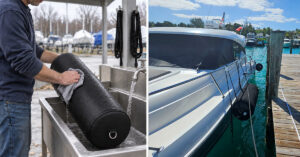
Good fender placement in wind and current comes down to having enough fenders, at the right height, where the boat is most likely to make contact. Set fenders before the final approach. A misjudged landing does far less damage when they’re already in position.
A few principles hold in most situations:
- Height: Hang fenders where your hull will meet the dock face. Too high and they ride up over the dock edge. Too low and the hull makes contact above them. For more on positioning and why fenders shift, see Why Your Fenders Keep Riding Up (and How to Stop It).
- Number: Carry at least three fenders on most cruising boats. Larger boats, rough conditions, or overnight stays call for more. See the AERÉ fender size guide for sizing by boat length.
- Bow and stern quarters: The corners of your boat are at highest risk during docking, especially when wind or current has the boat pivoting. Keep a fender near each quarter along with your midship coverage.
- Adjust for conditions: If you’re expecting the wind to push you onto the dock, check your fender height again once the boat has been pressed in. In surge, consider adding an extra fender tied at an angle to cover a wider surface area.
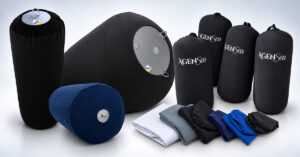
Inflation matters as much as placement. A fender that’s too soft bottoms out under load, and one that’s too hard bounces off the hull. Getting the pressure right makes a noticeable difference in how AERÉ inflatable fenders perform.
When to Abort and Try Again
Abort as soon as the boat stops doing what your plan expects. Nobody docks cleanly every time, and experienced captains have all needed a second attempt or watched conditions change mid-maneuver. Backing off is good judgment. A 30-second reset at low speed beats a rushed approach that ends with bent hardware or a damaged hull.
Pick an afternoon with no wind and no current and run through spring line techniques, approach angles, and stopping distances in your own boat, so the muscle memory is there when conditions turn. The U.S. Coast Guard Boating Safety Division has more resources for recreational boaters.
Docking Checklist for Wind and Current
Run through this list on your way into the marina. It’s also available as a printable checklist to keep aboard.
- Make a slow pass near your slip
- Identify the stronger force, wind or current
- Note whether it’s pushing you toward the dock or away from it
- Set fenders and ready lines before the final approach
- Match your approach angle to the wind direction
- Get a line on early when wind pushes you off the dock
- Approach into the current whenever you can
- Allow extra stopping distance with current behind you
- Abort and reset at low speed when the boat stops following your plan
If you have questions about sizing fenders or dock lines for your boat, contact the AERÉ team.
FREQUENTLY ASKED QUESTIONS
Captains must make a slow pass near the slip to determine whether the wind or the current is the stronger force pushing the vessel.
Watching environmental indicators allows crews to plan the safest approach before committing to the slip.
- Observe flags, smoke, and surface disturbances to gauge wind direction and strength.
- Monitor water moving around pilings or channel markers to determine current flow.
- Identify whether these environmental forces will push the boat toward the dock or away from it.
Approach the dock at a shallow angle of 10 to 20 degrees, cut the engine power, and allow the wind to press the hull safely alongside.
This scenario requires patience and minimal throttle to avoid striking the dock with excess momentum.
- Maintain a slow speed and use short bursts of reverse gear to control the final approach.
- Deploy fenders along the full length of the dock side before starting the maneuver.
- Position a specific bow fender at the forward corner to protect the vessel during the press-in.
Approach at a steep 45-degree angle carrying enough momentum to bring the bow close to the dock before cutting the power.
This situation forces the vessel away from the structure, requiring decisive line handling to secure the boat.
- Secure a temporary line around a forward cleat immediately upon reaching the dock.
- Use an after bow spring line and light forward throttle to pivot the stern into place.
- Ensure all forward fenders are fully deployed, as the bow usually lands first and hardest.
A spring line runs diagonally from the boat to the dock, acting as a fixed pivot point to maneuver the vessel using light engine throttle.
This rigging provides mechanical leverage that the steering wheel and engine cannot achieve on their own.
- A forward quarter spring runs from the stern forward to a dock cleat to prevent backward sliding.
- An after bow spring runs from the bow aft to a dock cleat to limit forward movement.
- AERÉ double-braid nylon dock lines absorb shock and handle these heavy pivoting loads safely.
Captains must hang at least three fenders at the correct height to protect the widest beam point and both the bow and stern quarters.
Proper placement ensures the hull remains protected when wind or current forces the boat to pivot unpredictably.
- Hang the equipment so it meets the dock face without riding up over the edge.
- Keep a fender stationed near the vulnerable bow and stern corners during tight maneuvers.
- Inflate AERÉ fenders to the correct pressure so they compress properly without bottoming out under load.